The difference between printing and embroidery comes down to one thing: embroidery stitches thread through fabric to create a raised, permanent design, while printing applies ink or dye onto the fabric surface. That single distinction determines how long your design lasts.
Everything else flows from that one distinction. Feel. Durability. Cost. The way your bag or garment ages after fifty washes.
So which should you choose? It depends on what you're making and how long you want it to last. Let's break down the real difference between printing and embroidery, method by method.
What Is Embroidery?
Embroidery is the craft of stitching thread through fabric to form a design. It becomes part of the cloth rather than sitting on top of it.
The technique is ancient. Some of the earliest surviving examples trace back to ancient China, where silk embroidery flourished and travelled along the Silk Road as a prized trade good.
Cultures across the world developed their own traditions, many of which are preserved in collections like the textile archives at the V&A and the vast holdings of the Metropolitan Museum of Art. If you want a deeper primer, our guide to what is embroidery covers the craft in more detail.
Today, embroidery splits into two camps.
Hand embroidery is slow, artisanal, and completely bespoke — every stitch placed by a person. Machine embroidery uses digitised designs fed into computerised machines that reproduce the same pattern precisely, again and again.
The thread itself matters as much as the technique. Cotton thread offers a soft, matte finish with a traditional look, but it's less resistant to fading and abrasion over time.
Polyester thread is the workhorse of modern embroidery — strong, colourfast, and built to survive repeated washing without losing its shade. Rayon sits somewhere in between, prized for its high sheen and vivid colours, though it's slightly more delicate than polyester.
As a rule of thumb, choose cotton when you want an understated, heritage feel on a piece that won't face heavy washing, and reach for polyester on anything destined for daily use, uniforms, or the outdoors. Save rayon for showpiece designs where a rich, glossy finish matters more than maximum durability — and explore the different types of embroidery to see how each thread suits a particular stitch style.
The choice of thread shapes the final look and, crucially, how well the design endures. Institutions like the Royal School of Needlework have preserved the finest of these stitching traditions for generations.
Both types share one quality that printing simply can't replicate: texture.
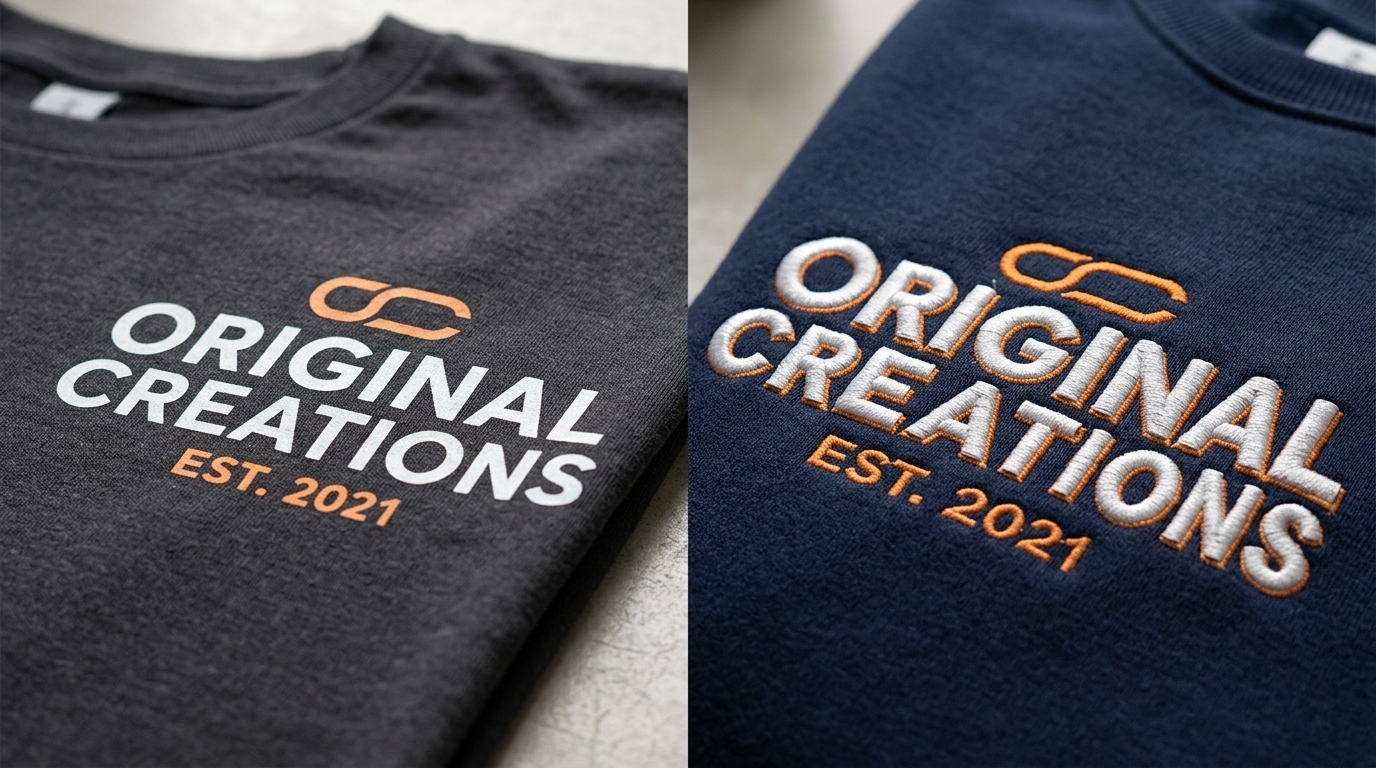
Run your finger across an embroidered logo and you feel it. The raised thread, the slight give, the density where the stitches cluster.
It's tactile. Physical. Something you notice before you even read the design.
That texture is the signature of embroidery. It's also the reason it reads as premium.

How Does Embroidery Compare to Screen Printing?
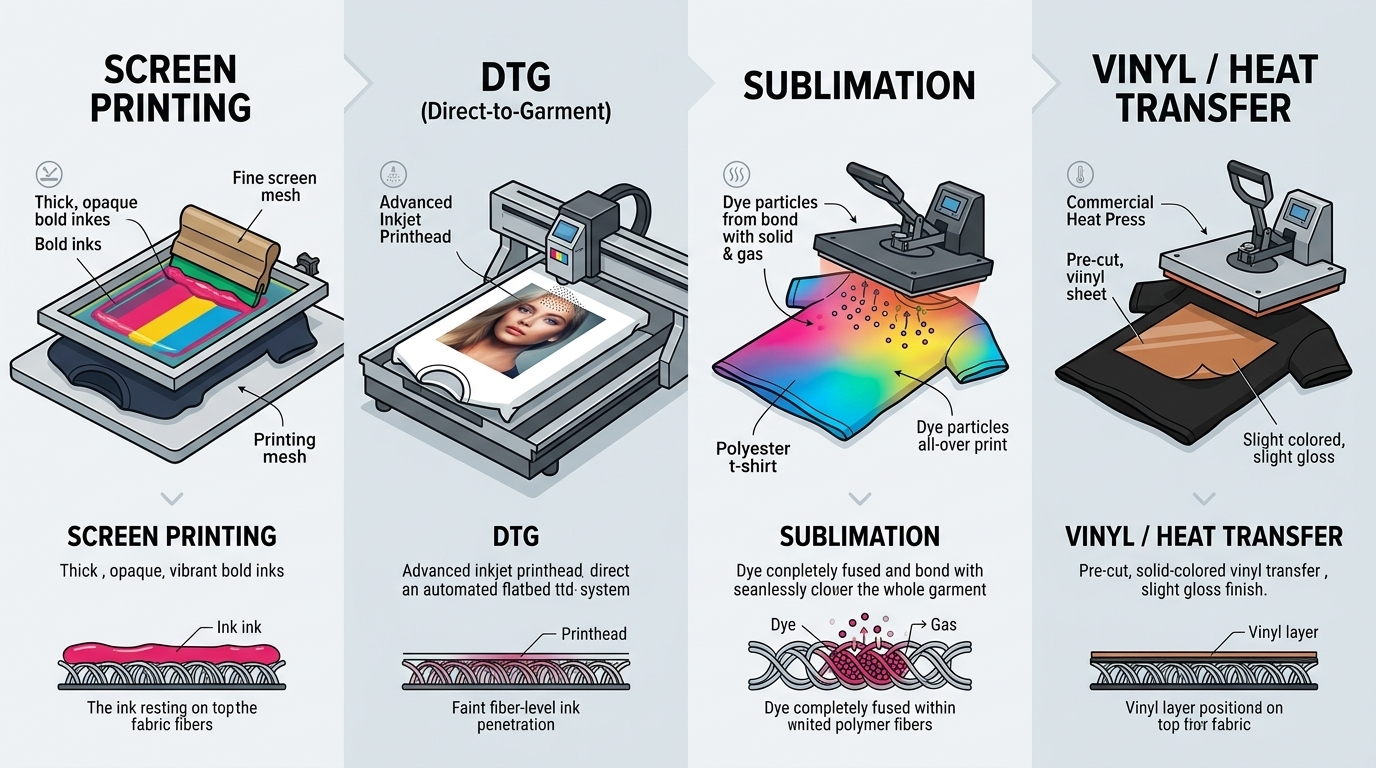
Screen printing lays flat ink on the surface. Embroidery stitches through the fabric. One can crack and peel over time; the other becomes part of the cloth.
That's the headline for embroidery vs screen printing. But the nuance is worth unpacking.
Screen printing shines when you need volume. Once the screens are set up, printing hundreds of identical shirts is fast and economical. The per-item cost drops sharply as numbers climb.
Embroidery flips that logic. It's better suited to smaller runs and personalisation — a name, a monogram, a single logo done beautifully. There's no screen to burn, so short runs don't carry the same setup penalty.
In the real world, the choice often reflects the type of business. A festival or promotional agency printing thousands of giveaway tees will lean on screen printing every time, because the economics simply make sense at scale.
A boutique coffee brand, a law firm outfitting staff, or a golf club ordering caps tends to reach for embroidery instead. These are businesses selling an impression of quality, and a stitched logo signals care in a way a flat print rarely does.
There's a branding perception at play here that goes beyond durability. When people encounter screen printing vs embroidery on a garment, the embroidered version almost always registers as the more considered choice — the raised texture reads as an investment rather than a giveaway.
That perception is why so many premium brands specify thread over ink for their core identity pieces, reserving print for seasonal or promotional runs where the message is bold and short-lived.
Then there's the feel.
A screen print is smooth. You can barely tell it's there by touch. Embroidery is dimensional — you feel the raised thread the moment you handle it. That physical presence is part of what makes it feel considered rather than mass-produced.
So which suits what?
Screen print a hundred event t-shirts on a budget. Embroider a run of premium caps, workwear, or a small batch of gifts where quality needs to show. Different jobs. Different tools.
How Does Embroidery Compare to Digital Printing (DTG)?
DTG prints full-colour, photographic detail directly onto fabric with a smooth finish. Embroidery can't match that detail — but it brings something DTG never will: three-dimensional presence.
This is the heart of embroidery vs DTG. Detail against durability.
Want a gradient sunset, a detailed illustration, or a photo reproduced across a chest panel? DTG handles it effortlessly. Colours are essentially unlimited, blending and shading exactly as your artwork intends.
Embroidery has limits here. Fine detail gets lost because thread has a minimum practical thickness. Tiny text, delicate shading, complex photos — these don't translate well to stitches.
Colour works differently too.
DTG mixes any colour on the fly. Embroidery draws from a physical inventory of thread spools, so your palette is defined by what's on the rack — beautiful, but finite.
Now the part that tips the balance.
Durability. Embroidery wins by a mile. DTG ink sits on the surface and softens or fades with repeated washing. Stitched thread holds its shape and colour far longer because it's woven into the garment.
Choose DTG for detailed, colourful, short-life or fashion pieces. Choose embroidery for anything you want to survive years of use. Uniforms, bags, and everyday carry all lean towards thread.
Which Lasts Longer — Embroidery or Print?
Embroidery lasts longer. Full stop. Stitched thread becomes part of the fabric, while printed ink sits on the surface and wears away.
If you're weighing up which lasts longer — embroidery or print — this is where the difference stops being about looks and starts being about years. It's also the clearest illustration of the printing vs embroidery difference in daily use.
Good embroidery uses colourfast thread that holds its shade for decades. It doesn't crack. It doesn't peel. It flexes with the fabric because it is the fabric now.
Prints don't age so gracefully.
Screen prints crack along fold lines. Vinyl lifts at the edges. DTG fades under sunlight and friction. Every wash cycle chips away at surface ink a little more.
Sunlight deserves special mention, because UV exposure is one of the harshest tests any design faces. Printed inks — particularly DTG and vinyl — are prone to noticeable fading after prolonged sun exposure, the pigments breaking down and dulling season by season.
Quality embroidery thread, especially polyester, resists UV far better. The colour is locked into the fibre rather than layered on the surface, so a stitched logo on an outdoor cap or garden tote holds its shade long after a printed equivalent has washed out to a ghost of its former self. Research bodies such as the Textile Institute have long studied how fibre and dye choices affect this kind of long-term colour retention.
Washing is where the gap becomes obvious. Following sensible textile care guidance extends the life of anything, but embroidery simply tolerates the machine better than print does.
Our full guide on how to clean embroidery walks through the small habits that keep stitched designs looking sharp for years.
This durability is exactly why commercial operators lean so heavily on thread. Hotels, airlines, and hospitality chains embroider staff uniforms almost without exception, because those garments are laundered industrially at high temperatures, sometimes several times a week.
A printed logo would crack and fade within weeks under that regime, but stitched thread survives cycle after cycle looking sharp. For a brand that lives or dies on its polished image, an embroidered crest is simply the only option that holds up.
Want a real-world test? Look at tote bags.
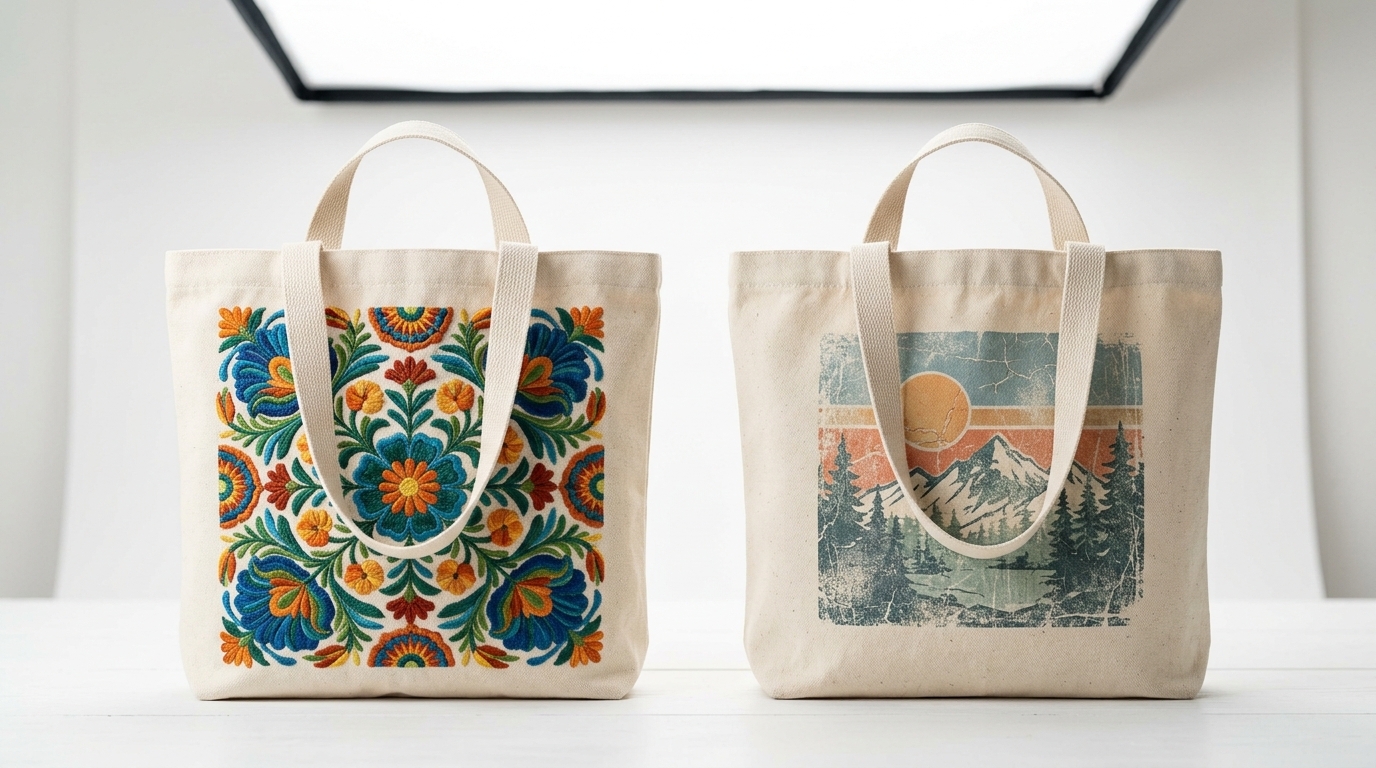
An embroidered tote carries its design year after year — through shopping trips, rain, and countless washes — with the logo intact. A printed tote from the same summer often looks tired within months, the ink faded and flaking after a single season of heavy use. Our own embroidered canvas totes are built with exactly this longevity in mind.
Or think about school badges.
Plenty of us remember embroidered school crests that outlasted the jumper itself — still crisp when the fabric around them had worn thin. That's not nostalgia. That's the physics of thread versus ink.
At Rivviv, we use colourfast polyester thread that holds its colour through 50+ washes. That's the standard embroidery sets and printing struggles to reach.
There's a sustainability angle too. A design that lasts means a product that lasts, which means fewer replacements. If you care about the wider picture, resources like Good On You are worth a read on how fabric choice and product longevity affect the environment.
Longevity isn't just a quality bonus. It's the greener choice.
Frequently Asked Questions
Can embroidery be removed?
No — it's stitched through the fabric, so removing it means unpicking every stitch and usually leaving needle holes behind. That permanence is the whole point. Embroidery is meant to stay, and that's why it's trusted for uniforms, workwear, and anything built to last.
What is cheaper, printing or embroidery?
It depends on the run. Printing, especially screen printing, is cheaper for large bulk orders once the setup is done. Embroidery is the better value for small runs, personalisation, and premium quality where the finish needs to feel considered rather than mass-produced.
Does embroidery work on all fabrics?
Not equally. Thicker, sturdier fabrics like cotton canvas, denim, and structured cotton take embroidery best because they support the weight of the stitching. Very delicate or stretchy fabrics can pucker or distort, so they need stabilising — or a lighter design.
Can you embroider over a printed design?
Yes. Combining the two is a popular technique — a printed base with embroidered detail on top adds dimension and texture to an existing design. You get the colour range of print and the tactile presence of thread in one piece. It's a smart way to keep a colourful graphic while still signalling the quality that stitching brings.
Why do printed designs fade faster?
Because the ink sits on the surface of the fabric rather than inside it. Washing, sunlight, and everyday friction all wear away that top layer over time. Embroidery avoids this entirely — the colour lives in the thread, not on the fabric's face.
Which looks more professional, embroidery or print?
Embroidery, in most cases. The raised texture and obvious permanence read as higher quality and more deliberate. Print has its place for bold, colourful, detailed graphics — but for logos, monograms, and premium finishes, thread simply looks the part. It's the reason established brands so often stitch their identity rather than print it.
By the RIVVIV Editorial Team · July 2026